
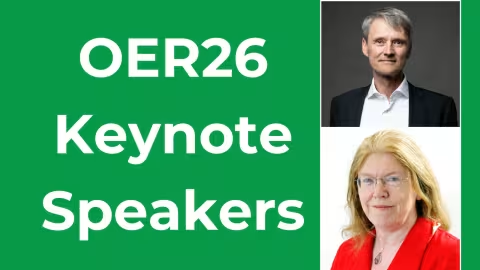
ALT is delighted to announce the two keynote sessions for the 2026 OER conference, taking place 22–23 June at The Open University in Milton Keynes. In keeping with this year’s theme, “Openness Reimagined: Continuity, Change and Shared Vision,” both keynotes will challenge, expand, and re‑envision what openness means for education, communities, and the wider public good.
Day 1 Keynote - Monday 22 June
Teaching, Learning and Researching in the Open
Prof. Eileen Scanlon
In this session, Professor Scanlon will explore her extensive experience in science education and educational technology through the lens of openness, a principle that has shaped her work and the mission of The Open University for more than five decades. Drawing on 57 years of institutional commitment to open access and open practice, she will trace how these values have informed her teaching, learning, and research.
A particular focus of her keynote will be her recent work in citizen science and inquiry. From developing platforms that support personal inquiry learning in schools to supporting communities in their own inquiries. Professor Scanlon will consider what is required to support openness in research.
This keynote promises to be a thoughtful and inspiring examination of how openness continues to shape educational innovation and how it can empower learners, educators, and researchers alike.
Day 2 Keynote - Tuesday 23 June
OER, Sustainability, and AI in Open, Distance, and Digital Education (ODDE)
Prof. Dr. Olaf Zawacki-Richter
Open Educational Resources (OER) have long been positioned as a cornerstone of more equitable, accessible, and participatory education. However, their long-term sustainability and quality remain persistent challenges. Drawing on recent evidence synthesis, this keynote takes a forward-looking perspective on the evolving role of OER within the broader field of Open, Distance, and Digital Education (ODDE).
Building on a systematic review of 226 studies, the talk highlights that OER sustainability is shaped by a complex interplay of macro-, meso-, and micro-level factors, including institutional policies, funding models, quality assurance, and the practices of educators and learners. In particular, quality and institutional support emerge as critical conditions for sustainable OER ecosystems. Complementing this, insights from research on OER quality assurance underline the need for robust frameworks and a shift toward open educational practices to enhance trust and adoption.
The keynote also addresses the rapidly growing influence of AI on open education. While AI offers new opportunities for the creation, adaptation, and dissemination of OER, it simultaneously raises concerns regarding quality, transparency, and environmental sustainability.
Explore the full keynote synopsis and keynote speaker bios.
__
These keynote contributions will help set the tone for a programme that explores openness as transformation, justice, care, innovation, and future‑focused practice. They reflect the conference’s commitment to bringing together diverse voices who are shaping the next chapter of open education.
As our keynote speakers open up new ways of thinking about what “openness” can mean in 2026 and beyond, we invite the wider community to join the conversation. The call for proposals for OER26 is open until 13 April, and we welcome submissions that help extend, enrich, and reimagine the discussions that will frame this year’s event.